C-Section Recovery
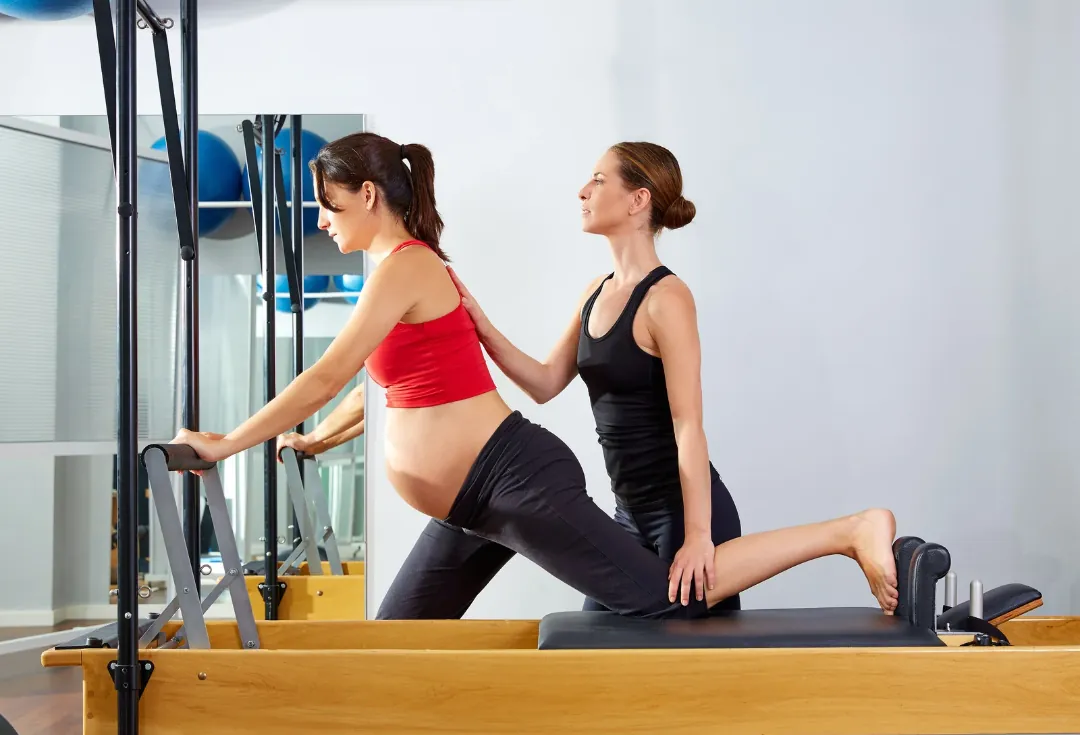
Is Pilates Safe During Pregnancy? When Can You Start?
Pilates during pregnancy is generally safe for women whose pregnancy is progressing normally and whose doctor has cleared them for exercise. When it is planned well, it can help ease low back and hip pain, make it easier to move comfortably, and help you get to know your body as you prepare for birth.
But there is one important point: pregnancy Pilates is not the same as a regular Pilates class. The exercises need to be adapted to your week of pregnancy, your energy level, and any symptoms you have.
Short answer: If your doctor has cleared you for exercise, you do not have to wait for a particular week. If you were not exercising before, the best approach is to start with short, gentle sessions.
Is Pilates safe during pregnancy?
Yes. In a low-risk pregnancy, Pilates done at an appropriate intensity and with the right modifications is safe. The World Health Organization recommends that pregnant women without medical contraindications get at least 150 minutes of moderate-intensity activity per week. Alongside walking, swimming and strength training, this activity can also include Pilates (World Health Organization, “Physical Activity”, 2024.).
The real value of Pilates is that it trains breathing, posture, balance, hip and core strength, and pelvic floor coordination together. Your goal should not be to “exercise a lot,” but to be able to use your body more comfortably throughout pregnancy.
What does the research say about Pilates?
Low back pain is very common in pregnancy. Studies report that more than two-thirds of pregnant women experience low back pain at some point during pregnancy. (de Souza Ferraz et al., “Effect of the Pilates Method on Pain and Quality of Life in Pregnancy”, 2023.)
A review published in 2026 that analyzed 13 studies found that pregnant women who did Pilates had musculoskeletal pain scores that were on average 2.59 points lower on a 0–10 pain scale. This is an encouraging result; however, because the programs differed from study to study, it would not be right to give everyone the same exercise list (Song et al., “Pilates During Pregnancy for Maternal Musculoskeletal Pain and Discomfort”, 2026.).
Another review published in 2023, covering a total of 65 pregnant women, found moderate-quality evidence that Pilates may reduce low back pain during pregnancy (de Souza Ferraz et al., “Effect of the Pilates Method on Pain and Quality of Life in Pregnancy”, 2023.).
In a small randomized trial, no exercise-related adverse events were reported among 21 low-risk pregnant women who did adapted Pilates for six weeks. This finding does not apply to high-risk pregnancies; an individual assessment is always needed (Mazzarino et al., “Feasibility of Pilates for Pregnant Women”, 2022.).
At what week of pregnancy can you start Pilates?
There is no one-size-fits-all rule such as “you should start at week 12.”
Can you start in the first trimester?
Yes, you can. If you have no bleeding, severe nausea or pain, and your doctor has not placed any restrictions on you, light, adapted exercise is possible in the early months of pregnancy too. If you feel tired, doing a shorter session or resting that day is completely normal.
Can you start in the second trimester?
Yes. During this period, the load on your lower back, hips and pelvis may start to increase. Working on posture, balance, hip strength and breathing can feel especially good.
Can you start in the third trimester?
Yes. At this stage the pace of the class is slowed down, and more supported positions, relaxation, breathing and birth-preparation-focused movements are chosen.
The best time to start: when your doctor has given you the go-ahead and you feel well. If you have no exercise background at all, starting with gentle 10–15 minute sessions is enough.
What are the benefits of Pilates during pregnancy?
It helps ease low back, upper back and hip pain
Pilates works the muscles around your trunk and hips in a controlled way. This makes everyday activities such as sitting down and standing up, walking, or standing for long periods more comfortable.
It teaches you to become aware of your pelvic floor
The pelvic floor muscles are not only muscles to squeeze; they also need to be able to relax when needed. In pregnancy Pilates, the goal is not to do Kegels all the time, but to become aware of this area together with your breath and learn to use it at the right moment.
It supports physical preparation for birth
Pilates does not guarantee a vaginal birth. However, using your breath, finding comfortable positions, getting to know your pelvis and listening to your body as you move are important parts of birth preparation.
How much and at what intensity should you do it?
You should feel comfortable enough to talk during exercise. If you are so out of breath that you cannot talk, or you are pushing yourself to keep going, the pace may be too high for you.
One to two days a week of pregnancy Pilates can be complemented with activities such as easy-paced walking on the other days. The 150 minutes of weekly activity recommended by the World Health Organization does not have to be done all at once; it can be spread throughout the day (World Health Organization, “Physical Activity”, 2024.).
What should you watch out for in pregnancy Pilates?
Not every exercise is right for everyone during pregnancy. When a class is planned, these points are generally kept in mind:
- Not forcing a movement through pain
- Not holding your breath or creating pressure as if you were bearing down
- Modifying movements that carry a risk of falling
- Changing position if lying on your back for a long time causes dizziness or nausea
- Not trying to overstretch
- Staying hydrated and not exercising in very hot environments
Abdominal exercises are not off-limits for everyone, either. What matters is whether you feel pain, hold your breath, notice obvious doming of your belly, or feel downward pressure during the movement. If you notice these signs, the exercise should be modified.
Who should always talk to their doctor before starting?
It is a good idea for every pregnant woman to talk with her OB-GYN before starting a new exercise program. An individual assessment is especially needed in the following situations:
- Vaginal bleeding or a history of recurrent bleeding
- Risk of preterm birth
- Placenta-related problems
- Cervical insufficiency or a cerclage
- Serious blood pressure, heart or lung disease
- Multiple pregnancy (twins or more)
- Any other condition that requires your doctor to limit exercise
If during exercise you have bleeding, leaking fluid, regular painful contractions, chest pain, a feeling of fainting, shortness of breath that does not go away at rest, a severe headache, calf pain or swelling, or a noticeable decrease in your baby’s movements, you should stop exercising and contact your healthcare team.
Frequently asked questions
Does pregnancy Pilates increase the risk of miscarriage?
In women whose pregnancy is progressing normally, exercise at an appropriate intensity has not been shown to increase the risk of miscarriage. However, if you have bleeding, pain or a risk your doctor has pointed out, your exercise plan should be individualized.
I have never exercised before. Can I do Pilates?
Yes, in a low-risk pregnancy you can start. But it is safer to start not with advanced videos from social media, but with a short, calm program adapted to you.
Does pregnancy Pilates make a vaginal birth easier?
It does not guarantee how you will give birth. It is more accurate to think of Pilates as something that “prepares” you for birth by supporting body awareness, breathing and comfortable movement.
Can you do Pilates every day during pregnancy?
You do not need to do intense Pilates every day. Light daily movement and walking can feel good. How often you do Pilates should be based on your week of pregnancy, your energy level and your symptoms.
Conclusion
When it is planned properly, Pilates during pregnancy is a safe and beneficial exercise option. What matters most is not which week you start, but how your pregnancy is progressing, what you need, and whether the program is right for you.
At Mama Healing, we do not see pregnancy Pilates as simply teaching movements. We assess your week of pregnancy, your pain, your daily life and your needs around birth to create a movement plan that suits you.
You can book an in-person appointment on Bağdat Caddesi in Istanbul, or an online assessment and pregnancy Pilates session.
Tuğçe Atalay, Specialist Physiotherapist
Istanbul

Author: Tuğçe Atalay, Specialist Physiotherapist
Last updated:
The information on this page is for general information only and does not replace diagnosis or treatment. Please consult your doctor and physiotherapist about your symptoms.