C-Section Recovery
Should You Wear a Belly Binder After Birth?
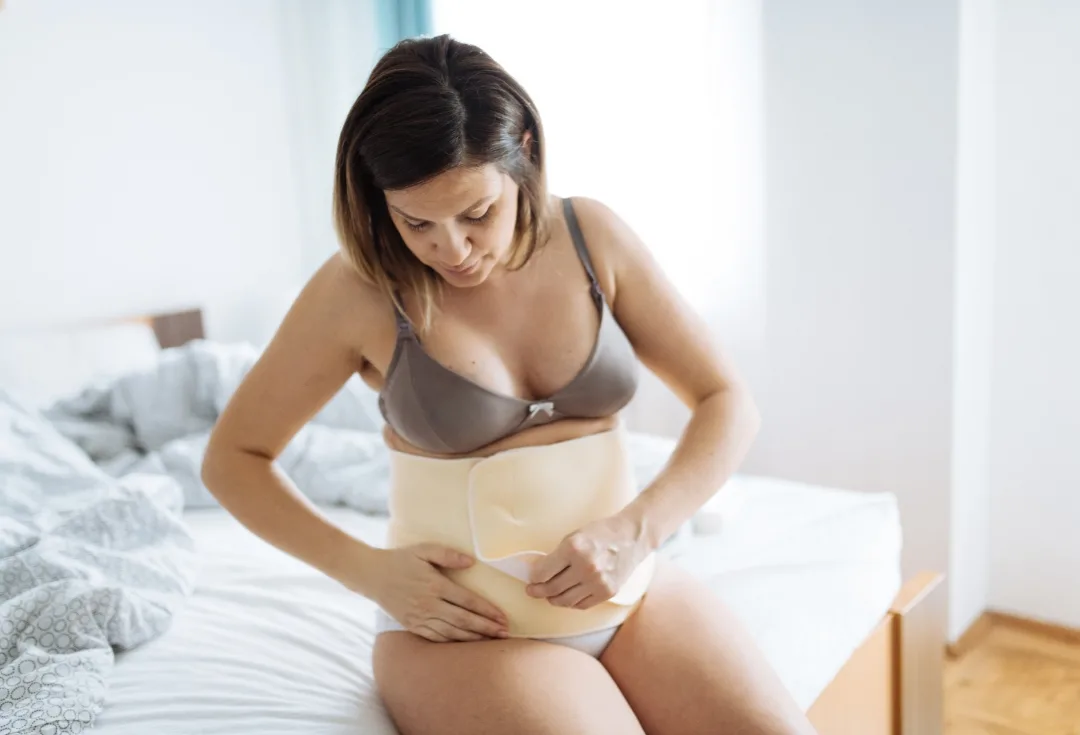
Short answer: Not everyone needs a binder after giving birth. In the first days after a C-section, a soft, supportive belly band can reduce pain and make it easier to move; studies on this are positive. But a binder does not heal your abdominal muscles, does not close abdominal separation (diastasis recti) and does not flatten your tummy permanently. Tight corsets that wrap the belly firmly to slim the waist can put extra pressure on the pelvic floor. So if you use a binder, the goal should be “moving comfortably,” not “slimming down”; use it for a short time and together with exercise.
What does a postpartum belly binder do, and what doesn’t it do?
When people say “postpartum corset” or “binder,” they usually mean one of two different products:
- Belly band (postpartum binder): A soft, stretchy band, usually with a Velcro closure. It wraps the belly gently without squeezing. Hospitals often recommend this type after a C-section.
- Tight corset and waist trainer: Made of latex or with boning. It wraps the belly and waist tightly and is sold to “slim down” and “flatten the tummy.”
Most research has looked at the first product, the belly band. The information below also refers to this type of band.
It helps with pain after a C-section
Many studies have looked at this, and the results are positive. In a 2025 analysis combining 13 studies, women who used a binder felt less pain during the first two days after surgery.
Women who used a binder also found that:
- walking and moving around was easier,
- pain interfered less with breastfeeding,
- there was no increase in wound problems.
The effect is not large. On a 10-point scale, pain dropped by about 1 point on average. But in the first days, when you get out of bed, cough or pick up your baby, that difference is clearly noticeable.
After a vaginal birth, the benefit is unknown
Binders and corsets are very commonly used after a vaginal birth. But there are not enough studies to show whether they help or harm.
Researchers do raise one caution: a binder can increase the pressure inside the abdomen. This pressure may affect the healing of pelvic floor muscles that were strained during birth.
It doesn’t close diastasis recti (abdominal separation)
When you wear a binder, your belly is held together and the separation looks smaller. But when you take it off, the gap between the muscles is the same.
Studies show two things on this topic:
- For reducing the separation below the belly button (diastasis recti), abdominal exercises are more effective than a binder.
- A binder can help some women feel better about themselves.
In short, a binder can boost your morale, but it can’t replace working your muscles.
It won’t flatten your tummy permanently
After birth, your uterus shrinks, swelling goes down and your abdominal wall recovers. This happens on its own over weeks and months. A binder doesn’t speed it up.
The slimmer look you get from a tight corset is temporary. When you take it off, your belly goes back to how it was.
Who can use a postpartum binder, and for how long?
If you had a C-section: If your doctor recommends it, you can use a soft belly band during the first days and weeks. In studies, the benefit was greatest in the first 48 hours after surgery and in the first week. The band is most useful when you get out of bed, walk and carry your baby; you can take it off while lying down and sleeping. As your pain eases, wear it for shorter periods.
If you had a vaginal birth: You usually don’t need a binder. If a “falling apart” feeling in your belly bothers you and a band makes you feel better, you can use a non-constricting band for a short time. If you have urinary leakage, or a feeling of heaviness or bulging in the vagina, get a pelvic floor assessment before using a binder.
If you have pain in your pubic bone or hip bones: For pelvic girdle pain that continues after birth, a narrow pelvic support belt worn around the upper hips, rather than a belly band, may be used for a different purpose. This decision should be based on an assessment.
Whatever your situation, a binder is not a treatment on its own. As pain eases, it should be replaced by breathing, retraining your abdominal muscles and pelvic floor exercises.
What are the risks of wearing a binder or corset?
Pressure on the pelvic floor
Your abdomen, rib cage, diaphragm and pelvic floor work together like a closed box. When the middle of the belly is wrapped tightly, the pressure has to go somewhere: above, the movement of the diaphragm is restricted, and below, extra load is placed on the pelvic floor.
After birth, the pelvic floor muscles are already strained and still healing. That is why a tight corset can make symptoms worse, especially in women with:
- Urine or gas leakage
- Heaviness or fullness in the vagina, or a feeling that something is “coming down”
- Constipation and straining to have a bowel movement
If you have these symptoms, it makes sense to avoid a tight corset.
Restricted breathing
A tight corset that also wraps the lower rib cage makes it harder to take deep breaths. Diaphragmatic breathing is important for the recovery of both the pelvic floor and the abdominal muscles.
Does a binder make your muscles “lazy”?
There is no evidence that a belly band used for a short time to reduce pain weakens the muscles. The real problem is using a binder in place of exercise. Wearing a binder for months without ever working your abdominal muscles delays their recovery of strength.
Skin and wound problems
A corset that is too tight or not breathable can cause skin irritation, sweating and friction on your C-section scar. Check the wound area regularly.
If I use a binder, how should I choose it and how should I wear it?
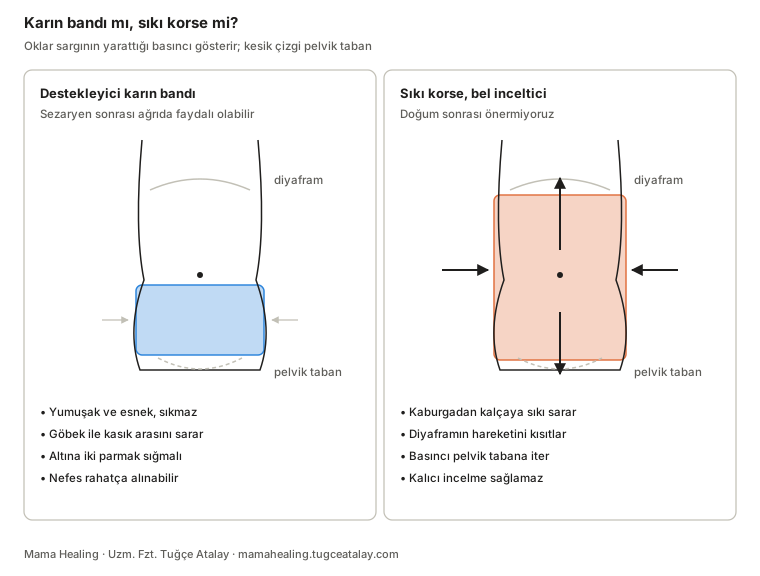
- Choose a soft, stretchy band. Avoid latex products, products with boning or anything sold as a “waist trainer.”
- Wear it in the right place. The band should wrap the area between your belly button and pubic bone, without squeezing your ribs.
- Check how tight it is. You should be able to slide two fingers under the band easily and take a deep breath.
- Put it on lying down. A band put on while lying on your back supports the belly gently inward and upward rather than pushing it down.
- Wear it when you need it. Put it on when getting up, walking and carrying your baby; take it off when lying down and sleeping.
- Check your skin and scar. If you notice redness, irritation or friction on the wound, wear it less.
- Take it off if leakage or heaviness gets worse. These symptoms can be a sign that your pelvic floor is under strain.
What should I do instead of, or along with, a binder?
What really helps your belly recover is your muscles relearning how to work properly. From the first days after birth, as far as your pain allows, you can start with the following:
- Diaphragmatic breathing: As you breathe in, feel your ribs widen to the sides; as you breathe out, feel your belly draw in gently. This is the first step in getting your abdomen and pelvic floor working together.
- Pelvic floor and lower abdomen on the exhale: As you breathe out, gently lift your pelvic floor and draw in below your belly button. Let go completely as you breathe in.
- Breathe out when you exert yourself: When getting out of bed, lifting your baby or coughing, breathe out instead of holding your breath. This reduces the pressure inside your abdomen.
- Roll to your side to get up: Especially after a C-section, instead of sitting straight up in bed, first roll onto your side and push up with your arms.
- Short walks: Light, frequent walks support both healing and regular bowel movements.
More demanding movements such as crunches, planks and heavy lifting should be introduced gradually, once your abdomen and pelvic floor are ready. A postpartum pelvic floor and abdominal wall assessment helps determine the right timing for this transition.
When should I see a specialist?
See your doctor or a pelvic floor physiotherapist if you have any of the following:
- Noticeable pain or a feeling of instability when you take the binder off
- Urine, gas or stool leakage that continues after birth
- Heaviness or fullness in the vagina, or a feeling that something is coming down
- A bulge or dip in the middle of your belly, especially when you strain
- Pain in your lower back, groin or tailbone that hasn’t eased after several weeks
If your C-section scar shows redness, discharge or opening, or if you have a fever, stop using the binder and contact your doctor right away.
Frequently asked questions
Does a postpartum belly binder flatten your stomach?
No, not permanently. Your uterus shrinks and your abdominal wall recovers on their own over weeks and months. A binder makes your belly look flatter while you wear it, but that look goes away once you take it off.
How long should you wear a binder after a C-section?
In studies, the benefit was greatest in the first 48 hours and the first week. As your pain eases, you can wear it for shorter periods. Follow your doctor’s advice on how long to use it.
Do you need a binder after a vaginal birth?
Usually not. There is not enough evidence that a binder helps after a vaginal birth. If you have urinary leakage or a feeling of prolapse, it is better to avoid a tight corset.
Can a binder close diastasis recti?
No. The separation looks smaller while you wear a binder, but it does not permanently close the gap between the muscles. In studies, abdominal exercises were found to be more effective than a binder for this.
Can you sleep in a postpartum binder?
There is no need. When you lie down, your abdominal muscles and pelvic floor are not under load. Wearing the band when getting up and moving around is enough.
Will my belly stay saggy if I don’t wear a binder?
No. What determines how your belly recovers is not a binder but retraining your muscles, time and your genetics. Women who don’t wear a binder also see their bellies recover over time.
Conclusion
A postpartum binder is not a must; it is a temporary support that can be useful in certain situations. In the first days after a C-section, a soft belly band can reduce pain and make it easier to move. But no binder or corset heals your abdominal muscles, closes diastasis recti or strengthens your pelvic floor. Tight corsets and waist trainers, on the other hand, can put extra load on your pelvic floor.
If you are wondering how your abdomen and pelvic floor are recovering, a postpartum assessment will show you which support to use and when. At Mama Healing, we plan your postpartum physiotherapy around your type of birth and your symptoms; you can see us in person in Kadıköy or, if you live outside Istanbul, get support online.

Author: Tuğçe Atalay, Specialist Physiotherapist
Last updated:
Sources:
• Lin SL, Yen CF, Hsieh CJ, Chang WP, Wang CH. The efficacy of abdominal binder in women undergoing cesarean delivery: a meta-analysis of randomized controlled trials. Midwifery. 2025;142:104281.
• Abd-ElGawad M, Said Ali A, Abdelmonem M, ve ark. The effectiveness of the abdominal binder in relieving pain after cesarean delivery: a systematic review and meta-analysis of randomized controlled trials. Int J Gynaecol Obstet. 2021;154(1):7-16. doi:10.1002/ijgo.13607.
• Di Mascio D, Caruso G, Prata G, ve ark. The efficacy of abdominal binders in reducing postoperative pain and distress after cesarean delivery: a meta-analysis of randomized controlled trials. Eur J Obstet Gynecol Reprod Biol. 2021. doi:10.1016/j.ejogrb.2021.05.014.
• Madison A, Bryan L, Gephart LF. Prevalence of planned abdominal binder use after vaginal delivery. South Med J.
• Conservative interventions may have little effect on reducing diastasis of the rectus abdominis in postnatal women: a systematic review and meta-analysis. Physiotherapy. 2023;119:54-71. doi:10.1016/j.physio.2023.02.002.
• Comparative efficacy of abdominal exercises and abdominal binding on diastasis recti abdominis reduction in postpartum women: a systematic review and meta-analysis of randomized controlled trials.
• Keshwani N, Mathur S, McLean L. The impact of exercise therapy and abdominal binding in the management of diastasis recti abdominis in the early post-partum period: a pilot randomized controlled trial. Physiother Theory Pract. 2021;37(9):1018-1033.
The information on this page is for general information only and does not replace diagnosis or treatment. Please consult your doctor and physiotherapist about your symptoms.