Diastasis Recti
Postpartum Recovery

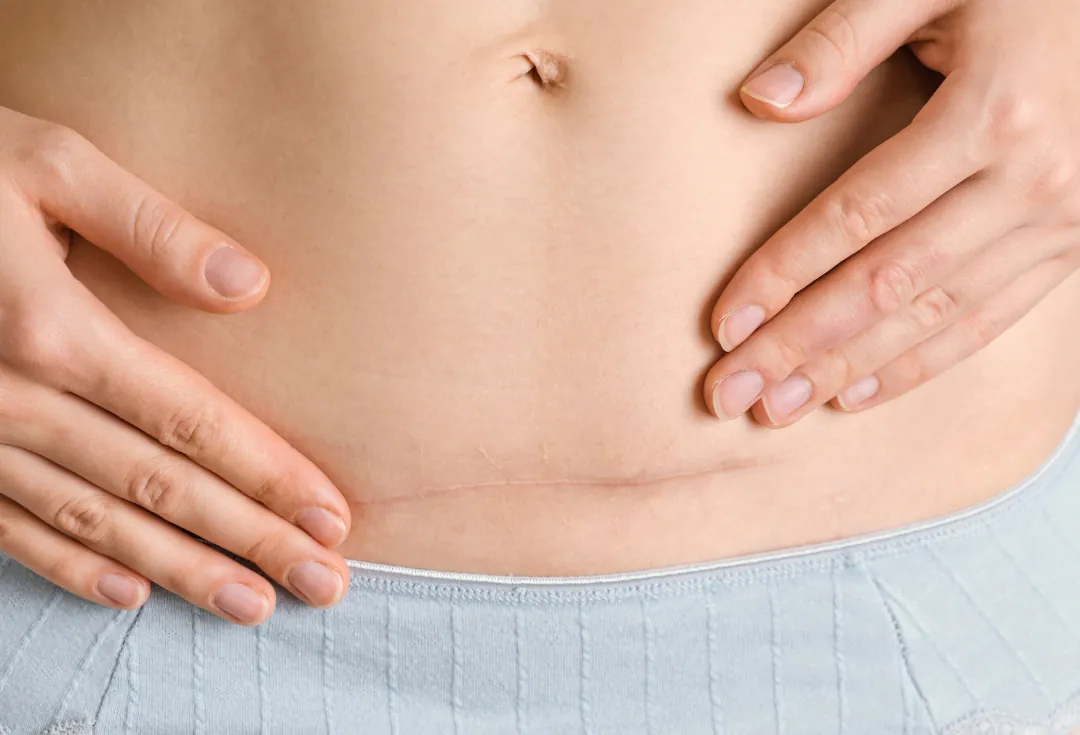
After a C-section, you may notice hardness, tightness, pulling, stinging or a feeling that the tissues are stuck together around the incision or in the lower abdomen. Some women feel it more when standing up, stretching, exercising or fully straightening the abdomen.
These complaints can be part of the normal recovery after surgery. However, if marked hardness and restricted movement persist for months, an assessment of the C-section scar and the mobility of the surrounding tissues may be needed.
A C-section does not affect only the skin. The surgeon reaches the uterus by passing through several tissue layers of the abdominal wall. After surgery, each of these tissues begins to heal.
The body forms new connective tissue to repair the incision. Early in this process, the tissue may feel hard, thick or tight.
Over time, the scar tissue remodels and usually becomes more flexible. In some people, however, the ability of the tissues around the incision to glide and move may remain limited.
In that case, even though the wound looks completely healed from the outside, you may still feel hardness or pulling in the area.
Normally, the skin and the tissues beneath it need to be able to move over each other to a certain degree.
Scar tissue that forms during healing after a C-section can reduce this mobility in some areas. As a result, with movements such as arching the torso backward, twisting, standing up or stretching the abdomen, you may feel “something pulling” at the incision site.
This sensation may not be right over the scar. It can be more noticeable above, below or to one side of it.
Newly formed scar tissue does not have the same properties as normal skin. Especially in the early stages of healing, it can be denser and more irregular in structure.
That is why a C-section scar may feel:
to you.
How a scar looks and how it functions are not always the same. Even a C-section scar that is thin and looks well healed from the outside can be restricted in its movement.
It is important to distinguish between two different things here.
Reduced movement of the C-section scar in the skin and the tissue under it relative to the surrounding tissues is not the same as intra-abdominal adhesions (internal adhesions) that may develop inside the abdomen after surgery.
Like other abdominal surgeries, a C-section can be associated with adhesions forming inside the abdomen. However, a pulling sensation in the abdomen or a hard scar alone does not necessarily mean you have internal adhesions.
So it is not correct to interpret every pulling sensation after a C-section as “there are adhesions inside.”
Healing varies from person to person. The skin closing does not mean the tissues have fully regained their previous mobility.
Scar tissue remodeling can continue for months. During this time, an area that was quite hard at first is expected to gradually soften and become more mobile.
However, if marked pulling, tenderness, hardness or restricted movement persists for months or even years, an assessment is helpful.
Some women notice a fold or bulge forming just above the scar after a C-section. Online, this is sometimes called a “C-section pouch” or C-section shelf.
There is no single cause for this appearance. Changes in the abdominal wall after pregnancy, fat distribution, skin changes, abdominal muscle function and tissue mobility around the scar can all play a role together.
So it is not accurate to say that scar massage alone will make this appearance disappear completely.
Once the wound has fully healed and it is clear there is no medical problem, scar mobilization and manual therapy techniques may be used for some people.
However, a freshly operated C-section area should not be massaged randomly or forcefully.
The goal of scar work is not to forcibly “break up” the tissue or “tear apart adhesions.” The goal is to assess how the tissue moves in different directions and, when needed, improve it in a controlled way.
Especially if there is pain or excessive sensitivity in the scar area, it is important to plan the treatment for the individual.
Physiotherapy after a C-section is not just about strengthening the abdominal muscles.
The assessment can look at your:
C-section scar mobility, abdominal wall function, breathing pattern, trunk movements, pelvic floor muscles and any diastasis recti together.
Depending on your needs, scar mobilization, manual therapy, breathing work, abdominal wall reactivation, trunk mobility work and a gradual exercise program may be used.
For example, if you feel a strong pull at the C-section site when you arch your torso backward, it is necessary to look not only at the scar itself but also at how the abdominal wall moves as a whole.
Not every bit of hardness or pulling means a serious problem. Especially early after surgery, it is expected that the tissues feel different.
However, if there is increasing redness, warmth, swelling, discharge, a bad odor, the wound opening, fever or severe/increasing pain in the area, this should not be considered normal scar healing, and you should see a healthcare professional.
For long-standing hardness, pulling or restricted movement without these signs, an assessment of the scar and abdominal wall function may be worth considering.
Especially in the early stages of healing, the area around the incision may feel harder than the other tissues. Over time, as the tissue remodels, the hardness can decrease. If marked hardness or pain persists for a long time, an assessment is recommended.
Reduced mobility of the scar and the tissues around it can cause a feeling of tightness and pulling in the area during certain movements.
A new or distinct, localized lump should not simply be assumed to be “scar tissue.” Especially if there is pain, redness or growth, it needs to be evaluated by a doctor.
Yes, in some people the mobility or sensitivity of the scar can stay altered for a long time. However, new pain, swelling or a lump that appears years later should be evaluated without automatically attributing it to the old C-section.
“Breaking up adhesions” is not an accurate description. Scar mobilization can be used to improve the mobility of the superficial tissues; it should not be thought of as breaking up adhesions inside the abdomen by hand.
Yes. Once wound healing is complete, a physiotherapy assessment can be done for ongoing scar sensitivity, restricted movement and problems with abdominal wall function.

Author: Tuğçe Atalay, Specialist Physiotherapist
Last updated:
The information on this page is for general information only and does not replace diagnosis or treatment. Please consult your doctor and physiotherapist about your symptoms.